
Chapter 3:
On Tmesis, Play and Paper Cranes

This one has been a long time coming. It features stories of improvised making and mending, thoughts on play and reflections on my visit to Hiroshima in November. There’s nothing graphic, but there is mention of the atomic bomb and its legacies. You should decide if you would like to read Towards Hiroshima, which is close to the end of this chapter.
I’m holding onto a thread that runs from Charlie Porter’s Bring No Clothes – I’m not yet done with it – through my hands and into my current work. It’s a thread, or thought, that travelled with me to and across Japan and finds its place in openness; a state of both being and materiality.
Porter’s mum, Pat, was a painter and a textile maker. His love for her is clear, ‘She has always been, and will always be, in every word I write.’ And with this declaration of love, I realise it only makes sense to use his given name, enough of this formality. Charlie’s continuing bond with his mum is sewing and it’s a particularly liberating one, especially when paired with the scissors Charlie takes to his beloved Hanes crewneck t-shirt a few days after her funeral, cutting out a square from its front for sewing machine practice and then launching into the ‘what if?’ that always so excited me as a student of art and design foundation. For Charlie, it’s ‘what if I tried to reattach the square?’
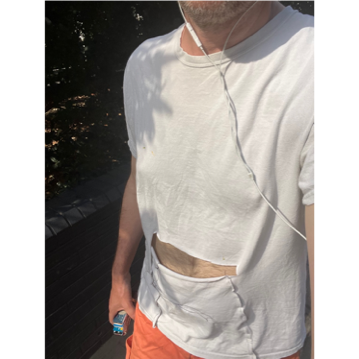
Charlie Porter and the ‘letter box’ t-shirt on their way to the British Library (Photo: Charlie Porter, with thanks)
Tenderly, I suggest there are two voids here. The one Charlie makes for himself, and the one that arrives unbeckoned. Together they are alchemic, activating a journey of self-discovery and creative energy that has me skipping to keep up with him as he dons his altered t-shirt, pops out ‘for something’ and then onto the British Library reading room with his ‘letterbox of flesh exposed.’
Charlie’s liberating ‘whatifness’ settled with me as I readied myself for a long-awaited trip to Japan, my head filled with thoughts of a capsule wardrobe (yes, I am laughing at myself). I wanted another pair of trousers, a warmer version of the grey pair I’d worn all summer. A smooth length of brushed cotton plaid, bought in a big birthday gift spending spree at Cloth House, called my name. I need to make it clear here that I’m a very poor dressmaker. No paper pattern to hand and little enthusiasm for that sort of making. My dress making is of a different kind and feels long forgotten, if not lost. It is a making born of school and church hall jumble sales, armfuls of fabulous stuff for 50p. A cardigan worn back to front, a sweater reduced to a tank top, a dress cut down to a skirt and fastened with a giant safety pin, and just once, a shirt worn as trousers. I wish I had visual evidence to share. Move on many years, and I really did fancy wearing my imagined bohemian plaid trousers, enjoyed the fantasy of resurrecting my early eighties garb. How to make it happen? And then Charlie’s ‘whatifness’ appeared to me as, ‘What if I just drew around the grey pair?’ I’d like to claim what follows as a self-drafted pattern, but it’s really not that expert.
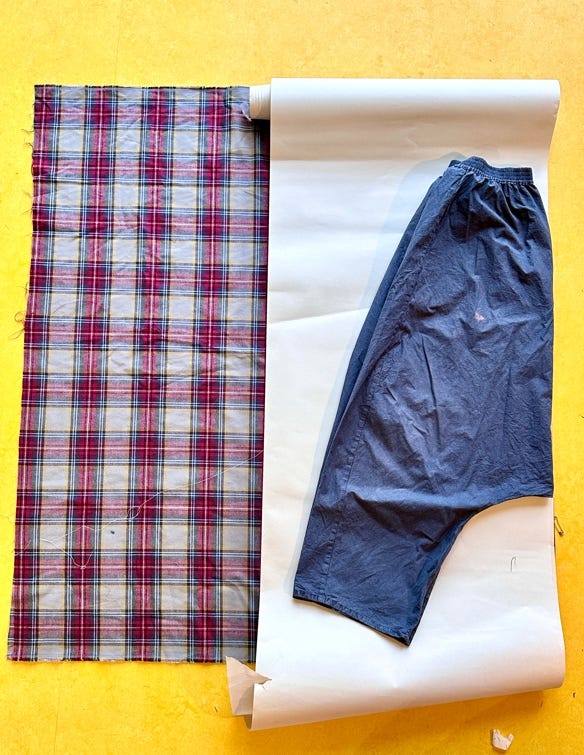
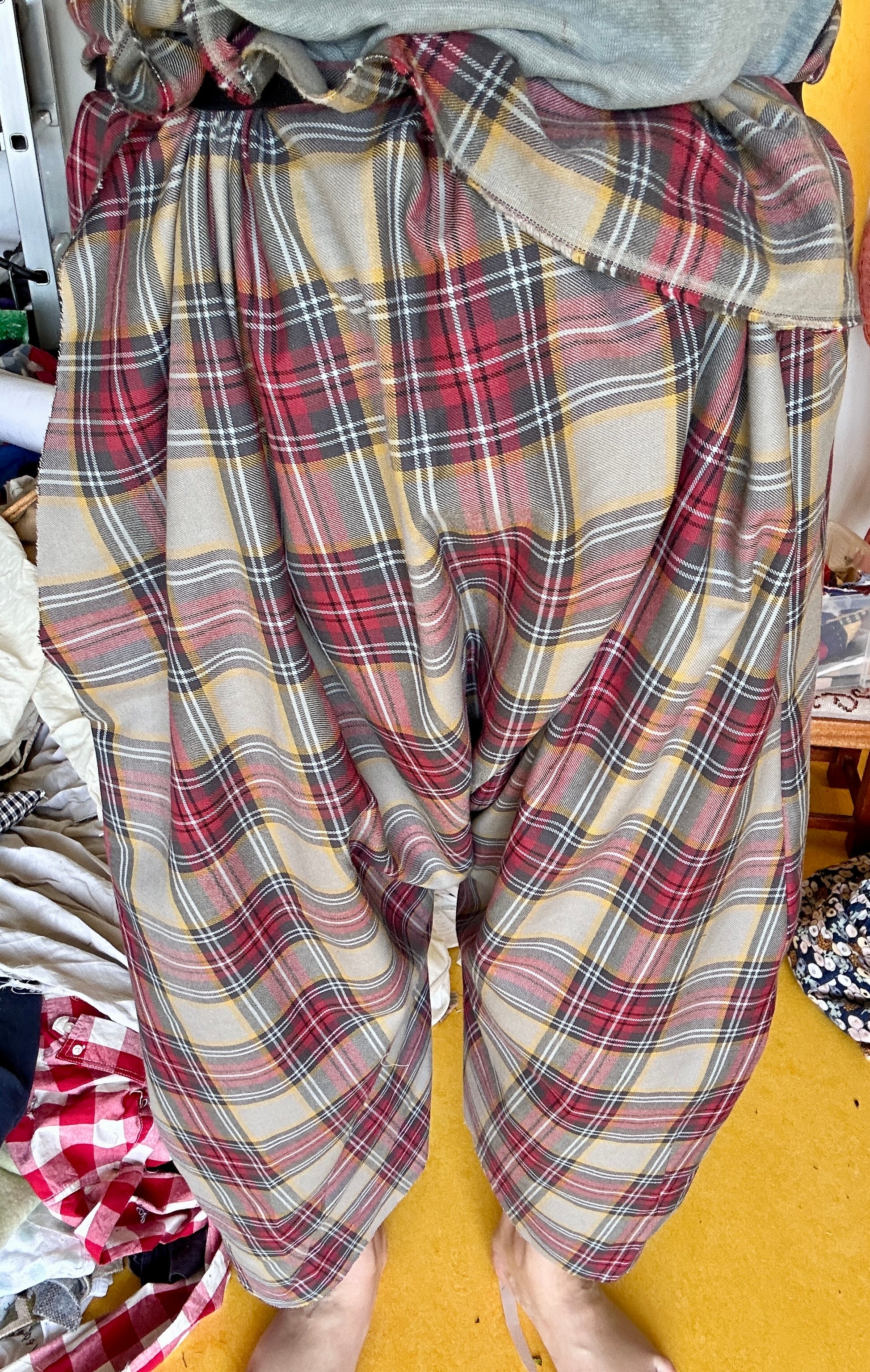
There they are, laid out on the floor, and again, before the waist band – of sorts – and the pockets. Their making is a resounding return to learning through process, and drawing out existing knowledge that’s mostly gained from the universal lived experience of wearing clothes, my habit. Make sure the waist band is high, I don’t like hipsters, keep the brushed side to the body, I’ll enjoy that, but not the pockets, I want to reach into their softness. I scavenge the waist band elastic from a pair of well-worn – in fact, still worn – striped cotton long johns.
My new trousers are washed, ironed, packed alongside my one other pair of capsule wardrobe trews, the grey pair – themselves newly patched to cover the hairdresser acquired bleach stains - and off to Japan. Except, in my usual way, there’s still work to be done. I hem them on a shinkansen between Tokyo and Matsumoto, enjoying the contrast of my imperfect slowness with the sleek speed of the train. I wear my plaid trews in Kyoto and Hiroshima. Across their museums, galleries, cafes and boulevards they dance. I do fancy myself in my striking self-made trousers. Their perfectly deep pockets, bed soft interior and voluptuous folds. I catch myself admiringly in mirrors. I try hard not to think Bay City Roller - if you know, you know - because they do feel like a return to something, and I notice I have a different energy when I wear them; even playful. Yet I rarely stand with my legs together and straight, I sense their legs don’t quite meet up, that I’m guilty of a bodge job. This isn’t a new feeling, but definitely a returned one. The late 70s cowboy boots, many sizes too large, their toes stuffed with cotton wool, worn with tucked in drum skin-tight black satin trousers and a white frilly oversized dress shirt. Yes, there was a touch of the New Romantic about me then, why let all my hair go to waste?
I also made a top, again by drawing around an old one, lengthening the sleeves and splitting the side seam at the hem. I tell this tale mostly because it shows what happens when we activate the ‘whatifness’ of creative thought. Neither garment is perfect, both might draw mutterings from my mum in their finish, but they are perfectly wearable. I’ve wanted to return to making my own clothes for years, but it was someone else cutting into theirs that motivated me.
Charlie’s cutting returned me to my PhD writing, particularly the idea of tmesis, which I borrowed from Roland Barthes.
Tmesis is a seam or flaw resulting from a simple principle of functionality: it does not occur at the level of the structure of languages but only at the moment of their consumption; the author cannot predict tmesis: he cannot choose to write what will not be read1
Tmesis has its roots in Latin and Greek from temnein, to cut. For Barthes, the act of cutting is in the hands – or mind – of the reader; what we might skip over, ignore or miss. What we might uniquely take for ourselves. These interventions are not just what we miss, but also what we add. Reaching back to ‘whatifness’, tmesis offers creative opportunities in language play that extend beyond cutting out, that become a cutting in. For written or spoken language, examples might be those words added, or cut into, phrases uttered in frustration, a misplaced and hunted for set of keys shifting from ‘my keys’ to ‘my damn keys’. You can have fun with tmesis, much more than I’ve had here. I think Charlie Porter and Bridget Harvey probably understand this better than me.
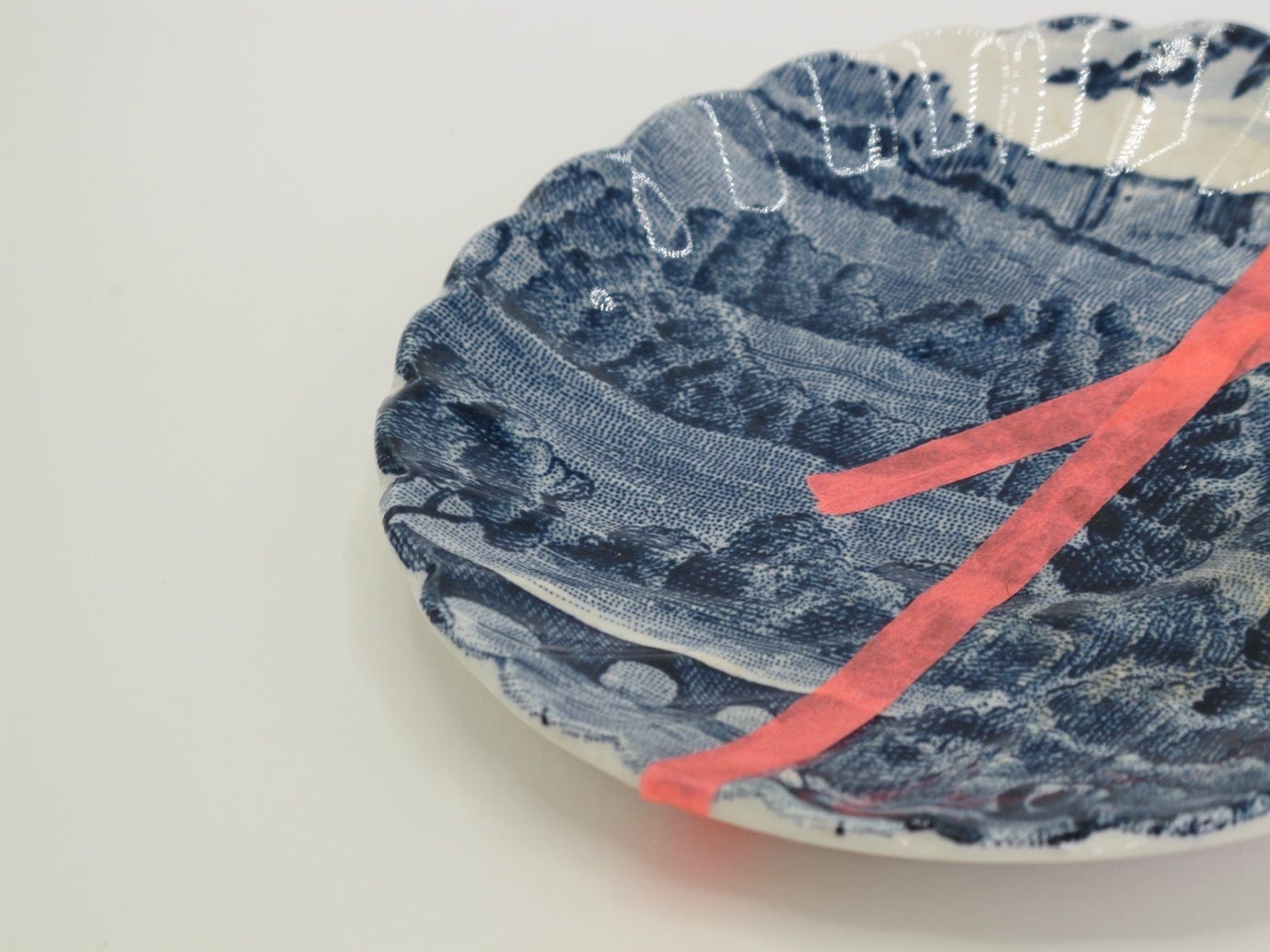
Washi Tape Plate, Bridget Harvey. Blue and White broken plate, pink washi tape (Photo: Bridget Harvey, shared with permission)
What I’m claiming is that tmesis, as described by Barthes, is just as relevant to the knitted garment or woven cloth as it is to text. All these things are products of language. If the first – the written word – can be disrupted or played with, then so might the others. Reaching back to Charlie, I claim he’s being utterly Barthesian in his tmesis or cutting in, profoundly so in his reinsertion of the cut-out rectangle, which now becomes a letter box. In written language, his ‘Hanes T-shirt’ becomes his ‘Hanes - letter box - T-shirt’.
Playfulness is something that too often eludes me. Artists – especially in art colleges – are encouraged to play with their materials, as a means of expanding ideas, and also for play itself. I find this appeal unnerving at best, I’m not sure I’m good at playing and I’m trying to unpick this. I imagine that being so influenced by the writing of the ‘Baby Watchers’ – D.W. Winnicott and Anna Freud particularly – has a role here. For them, a child’s play is something to be observed, even analysed. I bristle at the thought of being watched too keenly. I will try to resist making this a deep dive into my soul, but it is something that bothers me; my resistance to play, to being, as the Baby Watchers named it, ludic.
Three years ago, I bought a set of plates by mail order. One of the six arrived broken. I emailed the company about this, attaching an image, as requested, and they sent a replacement. A perfectly smooth interaction that stayed with me because of their twice repeated appeal to take care. The first email response ended with, ‘Please dispose of the item carefully after you have taken an image.’ The second, once I’d authenticated the damage with photography, ‘Please dispose of the broken item carefully.’ Oh, how their concern backfired.
I knew, the moment I read the second email, that I would not be disposing of this plate, carefully or otherwise. Conversely, I found myself caring for it, wrapping the broken shards in tissue paper and boxing them up. A few days later I wrapped one of the fragments in wool fleece, which I began to felt. I did need to take care at this point, hand felting requires gentle rubbing of fleece fibres against each other, this sort of making is all fingers, thumbs and palms, and the edges of broken ceramics are very sharp. Felting one shard took all morning, and I really did enjoy it. I’d like to say that three years on, the remaining shards are similarly wrapped, but they’re not, somewhere along the way I lost the thread and some other interest took their place. Except that writing about them has returned me to them, literally. A quick hurry to the studio confirms I still have them, though minus one shard, and there’s plenty of fleece. I claim this moment as a perfect example of how writing nourishes practice, let’s see where this goes. And, is there anything more ludicrous than mending a broken plate with felt?
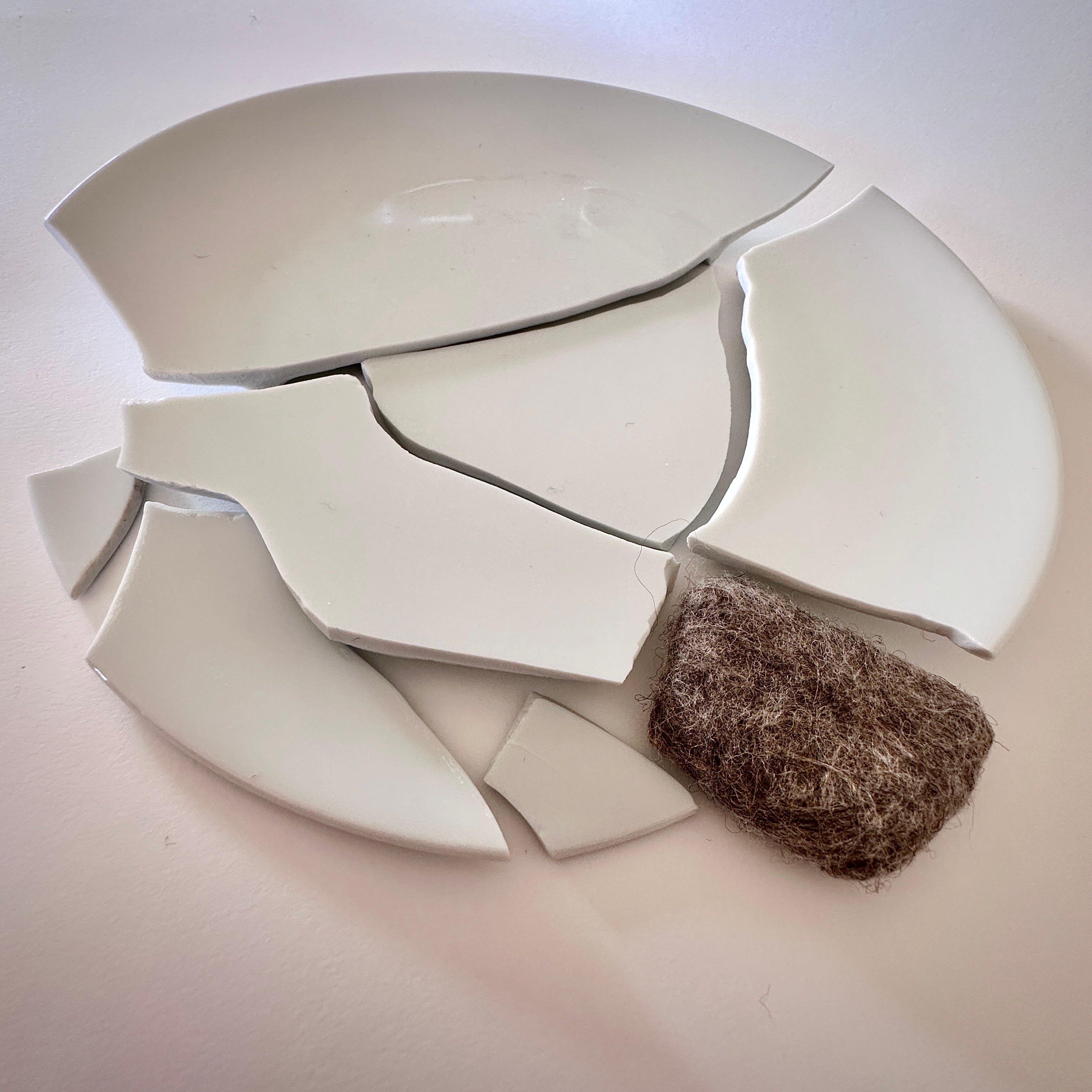
Accidentally Broken plate and Shetland Fleece
I’m revisiting work that has been too long on-the-go. A Work of seaming, of seamlessness, of joining and mending. The work explores the relationship between Sigmund Freud and his daughter, Anna. The younger Freud’s practice was primarily concerned with childhood observation, she being one of the ‘baby watchers’. I’m collaborating with Alicia Kent as King’s College, London. We write, we talk, I make, we respond. Way back in May we shared our practice with other King’s researchers, reading out loud extracts from our written conversations. I sat at my desk in Swansea, everyone else in a semi-circle around Alicia’s laptop in some place called the October Gallery at King’s. All of this made the event of our sharing very performative. Revisiting that text in the context of this writing, I see how thickly I’ve written about mending. I share some of that same writing here, because I think it speaks to this moment in time, marks mending as an interventionist, creative practice, one of community and connection. I think of visible mending as ‘seeing as believing’. It fits with Anna Freud’s practice of observation, of looking for.
My mending is visible. I always leave my mark. The opposite, invisible mending, is too much about disguise, of covering up the frayed edges of love and destruction, of masking the interventions of time. Invisible mending imposes seamlessness. This is not my goal. There must always be points of attachment, of bringing edge into play with edge, of recognising – AND seeing – the interplay of rough with smooth, of past with present.
Towards Hiroshima: Staying with the ‘frayed edges of love and destruction’, I want to share something of my visit to Hiroshima, specifically its Peace Park. I grew up with stories of the Hiroshima and Nagasaki atomic bombs and anticipated an emotional visit, what I hadn’t expected was that this area – the epicentre of the A-Bomb attack – would be so beautiful and compelling. It feels odd to describe a site of such appalling destruction in these terms, and yet I spent many hours of our four-day visit there walking, sitting, reflecting, enjoying the blue skies and autumn leaves.
There are two museum sites within the Peace Park. The largest The Hiroshima Peace Memorial Museum is deeply moving with many personal artefacts and testimonies. It left me, quite rightly, emotionally drenched. The smaller and newer Hiroshima Peace Memorial Hall is quieter and contains a visual register – the portraits and names – of all the victims of the atomic bomb.
There’s a small perspex case in the Hiroshima Peace Museum, it contains some of the paper cranes folded by Sadako Sasaki, a young girl who survived the initial bomb blast on August 6th 1945, becoming one of Japan’s hibakusha, but who would die of radiation acquired leukemia in 1955 at the age of twelve. The crane (orizuru) is a mystical creature in Japan, associated with longevity and good fortune, legend holds that whoever folds 1,000 paper cranes will have their wish granted. Origami, or paper folding, was a popular pastime in hospital wards and a few weeks before her death, Sadako began her quest to fold one thousand cranes using whatever paper she could find. The cranes in the perspex case include ones folded from the papers that wrapped her medicines. They are tiny, much smaller than the ones I would later make back home, Sadako using a needle to form some of the folds.
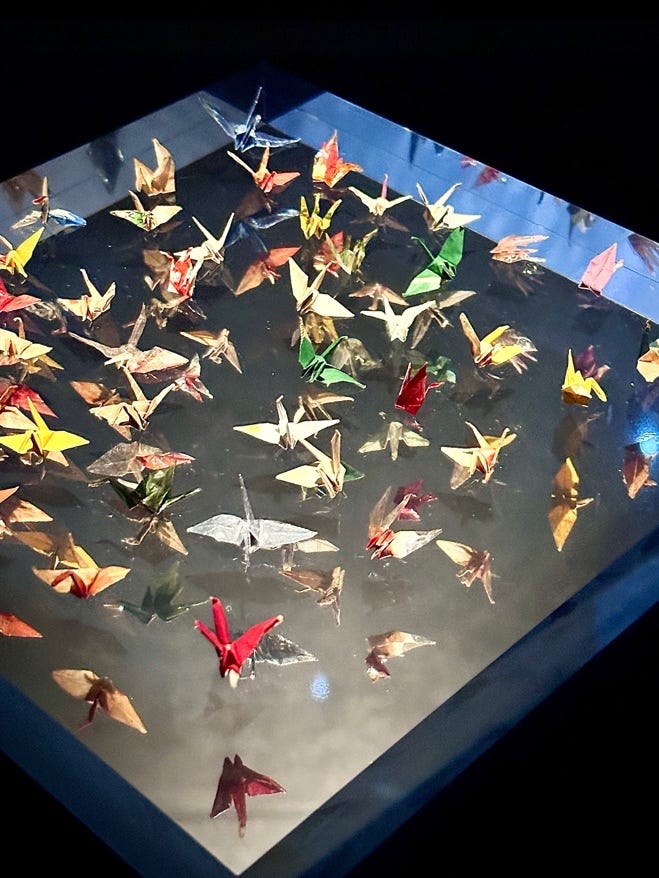
A Collection of Sadako Sasaki’s Cranes, Hiroshima Peace Museum (my image)
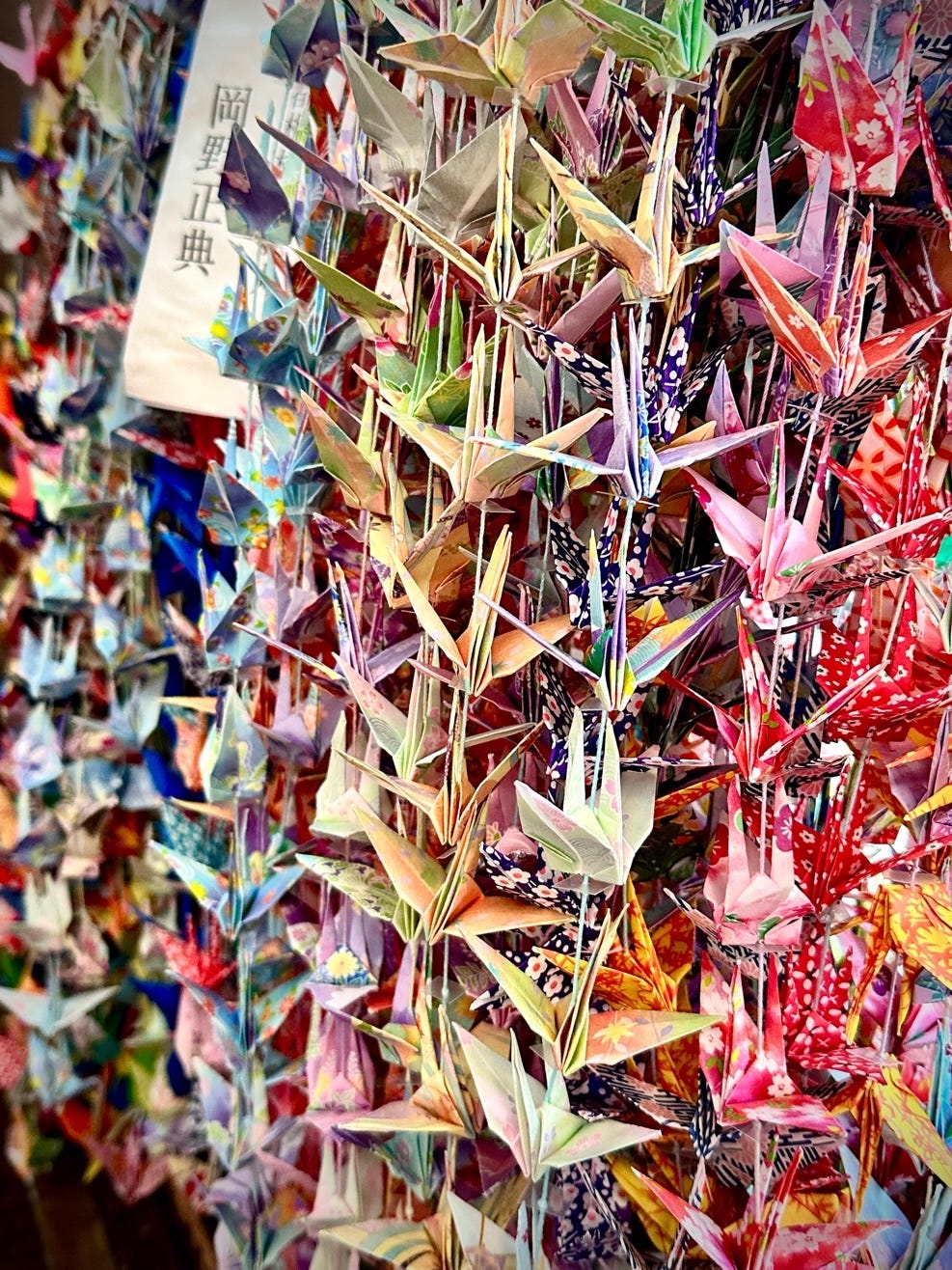
There are colourful paper crane garlands all over Hiroshima, but especially at The Children’s Peace Monument, where special provision is made for their collection and display. School children regularly leave garlands at the site and the city encourages contributions from overseas. The nine-metre high bronze memorial at the centre of the site was built with the contributions of more than 3,200 Japanese schools and unveiled on May 5th 1958. The young woman standing at the top of the sculpture is widely taken to represent Sadako Sasaki. The inscription at the memorial’s base reads ‘This is our cry, this is our prayer: for building peace in the world’.
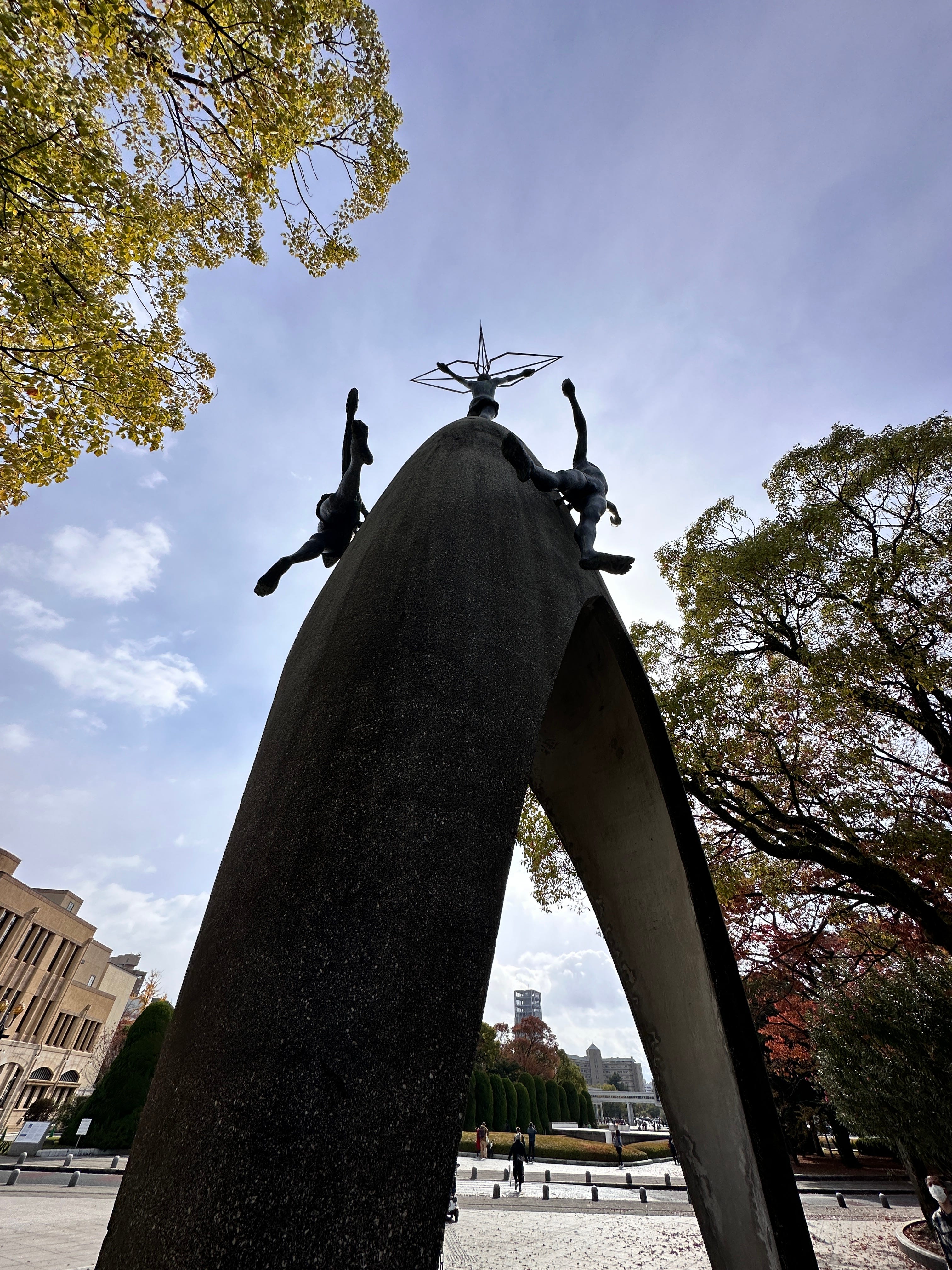
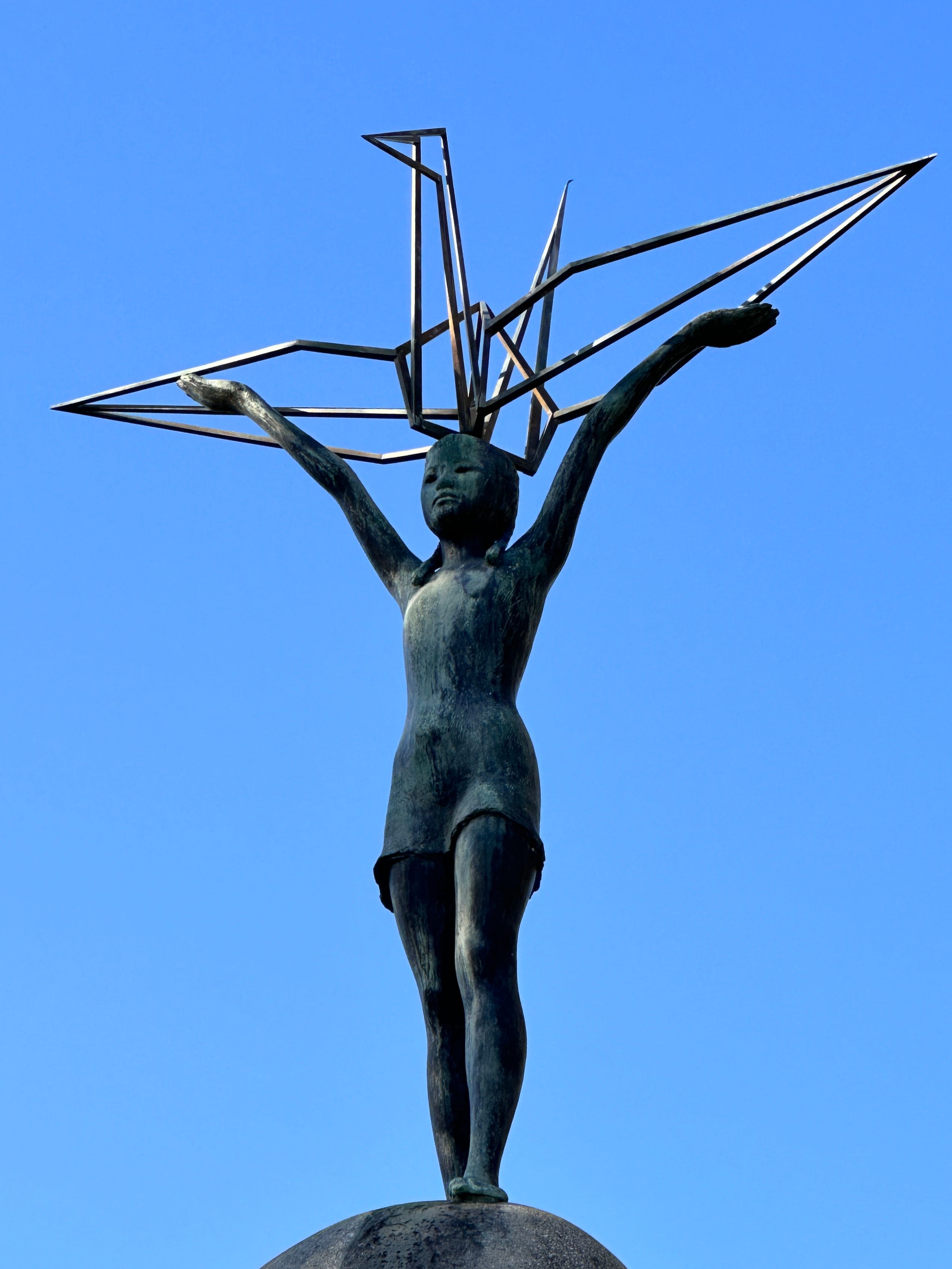
The Children’s Peace Monument, Hiroshima. Kazuo Kikuchi and Kiyoshi Ikebe, bronze, 1958 (my images)
I returned from Hiroshima with sewing needles and two packs of colourful origami paper, enough to make thirty paper cranes. I enjoy origami, particularly its silence and the quiet sense of achievement experienced when I can finally fold without Youtube guidance. I will sometimes challenge myself to fold a star or a cup without instruction. I spent a morning making the cranes, by the fourth I was on my own, blissfully folding, turning and creasing. My origami making is both a test and a pleasure, soothing but not as fluent as my sewing. The first is my borrowed language, the second my habit. I like to think of both as acts of mending and repair.
Afterthoughts
A Film: I finally watched The Dressmaker (Jocelyn Moorhouse) 2015, especially for Kate Winslet and the frocks. There’s magic realism at play here too.
The Nettle Dress – I wrote about it in Chapter 2, is now available to watch on-line in the UK and Ireland via Curzon Cinema
A Book: I’m going to revisit a favourite over the next week, Rebecca Solnit’s The Faraway Nearby. I have a dog-eared and much annotated copy, a proper companion.
An Exhibition: In November I recorded a conversation with Vivian Ross Smith about her Freelands Foundation Fellowship at Swansea College of Art. It was a long and discursive conversation, some of it to feature in a future Freelands Fellowship publication. Vivian’s exhibition Holding Places opens on January 8th.
Quilt with Me: My January/February workshop is full, but I am trialling a new way of learning. If the time zone doesn’t work for you, maybe you’d like to work at your own pace? I am offering a weekly recording of the skill sharing and contextual teaching - as well as all accompanying handouts - from each session for anyone wishing to learn with but can’t make the actual classes. Please contact me via Instagram or email for more information.
A Makers Retreat in South West France with Chloe Briggs aka Drawing is Free. This is a week-long drawing and textile retreat ‘Conversations between Drawing and Thread’ with both of us at Clos Mirabel, which is gorgeous. I’m travelling by ferry and car and will bring lots of samples, materials and textile books. Please contact Clos Mirabel to book a place, or me or Chloe for more information. Small group with limited places. 22 June - 29 June, 2024
Thank you if you have generously ‘bought me a coffee’ to support my work in Chapters One and Two. I have enough caffeine for now, but would like to ask that if you’ve enjoyed reading this, and have money to spare, you might instead make a donation to Save the Children’s Gaza Emergency Appeal. It only takes a few moments. Thank you.
Finally, however you celebrate this time of year - I’m falling towards solstice, hence my rush to get this finished in the next two hours - I send you my best wishes and my hope for a more peaceful coming year.
Barthes, R. (1975). The Pleasure of the Text (New York: Hill & Wang).
Love the trousers! Will you share a pic of the New Romantic you? Beautiful and deeply moving story about the cranes...
Tartan trousers always have a special place in my heart ( Woody was my favourite) Yours have a look of Westwood to them and are very appealing! Well done on embracing what if and naming it so, it feels so much less pressured than ‘to play’